Every time someone opens the fridge to grab milk or leftovers, they’re relying on a heat pump that’s been quietly humming in kitchens for over a century. Yet most homeowners have no idea what’s actually happening behind that insulated door. Understanding the refrigeration cycle isn’t just trivia, it helps diagnose problems early, avoid costly repairs, and make smarter decisions when replacing appliances. The process boils down to a closed loop of compression, condensation, expansion, and evaporation, all designed to move heat from inside the box to the outside air. Here’s how it all works.
Table of Contents
ToggleKey Takeaways
- A refrigerator works by continuously removing heat through a closed cycle of compression, condensation, expansion, and evaporation—not by creating cold.
- The four essential components in how a refrigerator works are the compressor, condenser coils, expansion valve, and evaporator coils, each playing a critical role in the heat transfer process.
- Regular maintenance, such as cleaning condenser coils every six months and checking door seals, can extend your refrigerator’s lifespan and significantly reduce energy costs.
- A refrigerator normally runs 80–90% of the time in warm weather, but continuous nonstop running usually signals issues like dirty coils, faulty door seals, low refrigerant, or a failing compressor.
- Modern Energy Star–rated refrigerators use 400–600 kWh annually compared to 1,200+ kWh for models from the 1990s, making replacement economical if an old unit runs constantly.
The Basic Principle: Heat Transfer and Refrigeration Cycles
Refrigerators don’t create cold, they remove heat. That’s a crucial distinction. The appliance uses a refrigerant (a chemical with a low boiling point) to absorb heat from the interior compartment and release it outside the unit, usually through coils on the back or bottom.
The refrigeration cycle is a continuous loop with four main stages: compression, condensation, expansion, and evaporation. The refrigerant changes state from gas to liquid and back again as it circulates, leveraging the thermodynamic principle that compressing a gas heats it up, and allowing a liquid to expand (or evaporate) cools it down.
This cycle is what allows a fridge to maintain a steady internal temperature, typically 35–38°F for the main compartment and 0°F for the freezer. Without this active heat removal, the insulation alone wouldn’t keep food cold for long. Ambient heat from the room, along with heat generated every time the door opens, would gradually warm the contents.
The Four Key Components That Make Refrigeration Possible
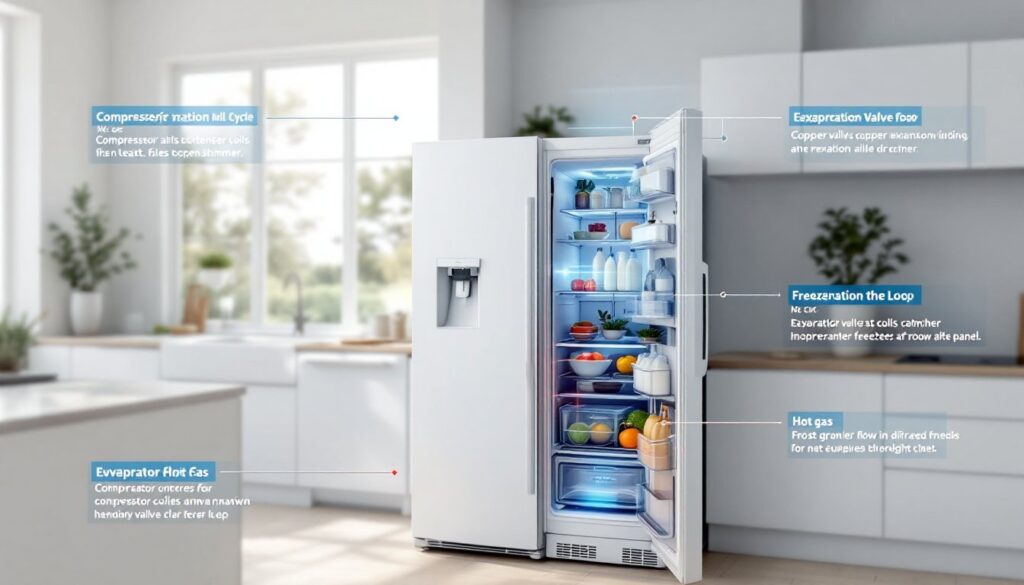
A refrigerator relies on four core parts working in sequence: the compressor, condenser coils, expansion valve (or capillary tube), and evaporator coils. Each plays a specific role in moving and transforming the refrigerant.
The Compressor: Your Fridge’s Hardworking Heart
The compressor is a motorized pump, usually mounted at the bottom rear of the unit. It pressurizes low-pressure refrigerant gas, raising both its pressure and temperature. This hot, high-pressure gas then moves into the condenser coils.
Compressors cycle on and off based on input from the thermostat. When the interior temperature rises above the setpoint, the compressor kicks in. Modern units often use inverter compressors that can vary speed rather than simply turning on and off, improving efficiency and reducing temperature swings.
If the compressor fails, the fridge stops cooling entirely. Homeowners often hear a click when it tries to start but can’t, a sign of a failing motor or capacitor. This is one repair that typically requires a professional, as it involves handling pressurized refrigerant and sealed systems.
Condenser Coils: Releasing Heat to Keep Things Cool
Once the hot, pressurized gas leaves the compressor, it flows into the condenser coils, a series of thin metal tubes (often steel or copper) that snake across the back or underneath the fridge. As the gas travels through these coils, it releases heat to the surrounding air and condenses into a high-pressure liquid.
This is why the back of a refrigerator feels warm. The condenser is literally radiating the heat it pulled from inside the box. A small fan (found on many models) helps move air over the coils to speed up heat dissipation.
Dust and pet hair buildup on condenser coils is one of the most common causes of inefficiency. When coils are clogged, they can’t release heat effectively, forcing the compressor to run longer and work harder. Cleaning them every six months with a coil brush or vacuum attachment can extend the appliance’s lifespan and cut energy costs.
After the refrigerant condenses into a liquid, it moves to the expansion valve (or capillary tube), a narrow passage that controls the flow of refrigerant into the evaporator. As the high-pressure liquid passes through this restriction, it rapidly expands and its pressure, and temperature, drop sharply. This cold, low-pressure liquid then enters the evaporator coils inside the fridge.
The Step-by-Step Refrigeration Process Explained
Here’s how the cycle unfolds in real time:
- The compressor pressurizes the refrigerant. Low-pressure gas enters the compressor and exits as a hot, high-pressure gas.
- The condenser coils cool the refrigerant. The gas flows through the coils, releasing heat and condensing into a high-pressure liquid.
- The expansion valve drops the pressure. The liquid refrigerant passes through a narrow opening, causing a rapid drop in pressure and temperature.
- The evaporator coils absorb heat. The cold, low-pressure liquid enters coils inside the fridge (often hidden behind panels in the freezer section). As warm air from the interior flows over these coils, the refrigerant absorbs that heat and evaporates back into a gas.
- The cycle repeats. The now-warmed, low-pressure gas returns to the compressor to start the loop again.
A thermostat monitors the interior temperature and signals the compressor when to cycle on or off. On older units, this is a mechanical dial. Newer models use electronic sensors and control boards.
The evaporator fan (inside the fridge) circulates air over the evaporator coils and throughout the compartments, ensuring even cooling. If this fan fails, you might notice the freezer staying cold while the fridge section warms up.
Many units also include a defrost heater and timer. Because moisture in the air condenses and freezes on the evaporator coils, frost builds up over time. The defrost cycle periodically warms the coils just enough to melt the ice, which then drains away. Frost-free models automate this process: manual-defrost units (common in older chest freezers) require periodic user intervention.
Why Your Refrigerator Runs Constantly (And When to Worry)
It’s normal for a fridge to run in cycles, typically 80–90% of the time in warm weather or after heavy use. But continuous running with no off cycles can signal a problem.
Common causes include:
- Dirty condenser coils. Dust buildup prevents heat release, forcing the compressor to run nonstop.
- Faulty door seals (gaskets). Gaps allow warm air to leak in. Test by closing the door on a dollar bill: if it pulls out easily, the seal may need replacement.
- Low refrigerant charge. If the sealed system develops a leak, refrigerant levels drop and cooling efficiency plummets. This requires a licensed technician to diagnose and repair.
- Overstuffed interior. Blocking airflow around vents or packing the fridge too tightly restricts circulation, making the unit work harder.
- High ambient temperature. If the fridge is in a hot garage or next to an oven, the compressor has to run longer. Most appliances are rated for operation in ambient temperatures between 55–110°F.
- Aging compressor or failing thermostat. Components wear out. If the fridge is over 15 years old and struggling, replacement may be more economical than repair.
Homeowners should also listen for unusual sounds. A clicking noise that doesn’t lead to startup often means a bad compressor relay or capacitor. A loud rattling can indicate a failing fan or loose parts. Most of these issues are repairable if caught early.
Energy efficiency matters, too. According to testing standards used by appliance reviewers, modern Energy Star–rated refrigerators use about 400–600 kWh per year, compared to 1,200+ kWh for models from the 1990s. If an old unit is running constantly, the electric bill often justifies an upgrade.
Conclusion
A refrigerator’s elegance lies in its simplicity, four components, one chemical loop, and the relentless movement of heat. Keeping condenser coils clean, monitoring door seals, and listening for changes in compressor behavior can add years to an appliance’s life. And when something does go wrong, understanding the cycle helps homeowners explain symptoms clearly to a tech, or decide whether it’s time to shop for a new model.