Swapping a traditional tank water heater for an electric tankless unit isn’t just about saving space, it’s about never running out of hot water mid-shower again. Unlike their gas counterparts, electric tankless water heaters don’t need venting, which makes them appealing for DIYers. But don’t mistake that for “easy.” These units demand serious electrical upgrades, precise installation, and a clear understanding of your home’s capacity. This guide walks through everything needed to install an electric tankless water heater safely and correctly, from sizing your electrical panel to making the final connections. If you’re comfortable working with high-voltage wiring and have the right permits in hand, this project is achievable in a weekend.
Table of Contents
ToggleKey Takeaways
- Electric tankless water heater installation requires substantial electrical upgrades, with units drawing 60–150 amps and often necessitating a panel upgrade costing $1,500–$3,000.
- Proper sizing is critical: match your unit’s amperage rating and wire gauge to code requirements, as undersized wire creates fire hazards and violates the National Electrical Code.
- Calculate your hot water demand based on gallons per minute (GPM) and temperature rise; a whole-house unit may not suffice if multiple showers run simultaneously, making point-of-use heaters a viable alternative.
- Always obtain required permits and pass inspections before installing an electric tankless water heater, as skipping this step can cause issues during home sales and insurance claims.
- Install shut-off valves, a pressure relief valve with discharge tube, and verify all connections for leaks to ensure safe operation and prevent catastrophic overpressure failures.
- Confirm power is off using a voltage tester before any electrical work, and never attempt high-voltage wiring without proper training—hire a licensed electrician if you’re uncomfortable with this critical safety step.
What You Need to Know Before Installing an Electric Tankless Water Heater
Electric tankless water heaters heat water on demand, which sounds great until you realize they pull anywhere from 60 to 150 amps during operation. That’s substantially more than most household appliances. Before buying a unit, check the existing electrical panel. Most homes have 100-, 150-, or 200-amp service. If the panel is already near capacity or you’re installing a whole-house unit, an upgrade is likely necessary.
Size matters. A small point-of-use unit for a bathroom sink might only need a 30-amp breaker and 10-gauge wire. A whole-house unit serving multiple fixtures simultaneously could require dual 60-amp breakers and 6-gauge copper wire. Always match the unit’s amperage rating to the circuit, undersized wire creates a fire hazard and violates the National Electrical Code (NEC).
Check your municipality’s permit requirements before starting. Most jurisdictions require a permit for new electrical circuits above 30 amps, and inspections ensure the work meets code. Skipping this step can cause headaches during home sales or insurance claims.
Water flow rate is another critical factor. Electric tankless heaters are rated in gallons per minute (GPM) at a specific temperature rise. If your incoming water is 50°F and you want 120°F output, that’s a 70°F rise. A unit rated for 3 GPM at 70°F rise can handle one shower. Two showers running at once? You’ll need a larger unit or multiple heaters.
Consider whether instant water heater installation at individual fixtures makes more sense than a single whole-house unit. Point-of-use heaters reduce wait time, cut heat loss in long pipe runs, and split the electrical load across multiple circuits.
Electrical Requirements and Panel Upgrades
Most whole-house electric tankless units require 240-volt circuits with dedicated double-pole breakers. The smallest units pull 60 amps: larger models demand 100+ amps, sometimes requiring two separate circuits. If the existing panel can’t accommodate this, a panel upgrade is non-negotiable.
Panel upgrades typically involve replacing the entire service panel, upgrading the meter base, and sometimes the service entrance cable from the utility connection. This is a job for a licensed electrician in nearly every jurisdiction, it’s not just difficult, it’s illegal for unlicensed individuals to perform this work in most areas.
Budget for this. Panel upgrades run $1,500 to $3,000 or more depending on your region, existing infrastructure, and whether the utility company needs to upgrade the service drop. Factor this into the total project cost before committing to a whole-house electric tankless system.
Even if your panel has capacity, you’ll need to install new circuit breakers and run heavy-gauge wire. For a 60-amp circuit, that’s 6-gauge copper wire (or 4-gauge aluminum, though copper is preferred). For 80-100 amp circuits, you’re looking at 4-gauge or larger. This wire isn’t cheap, and it’s stiff enough to make routing through walls and joists a real workout.
Tools and Materials Required for Installation
Gather everything before starting. Running to the hardware store mid-project with the water shut off is nobody’s idea of fun.
Tools needed:
- Voltage tester (non-contact and two-lead type)
- Wire strippers and cutters rated for 6-gauge or larger wire
- Screwdrivers (flathead and Phillips)
- Adjustable wrench or pipe wrench
- Level (torpedo or 2-foot)
- Drill with masonry or wood bits (depending on mounting surface)
- Pipe cutter or hacksaw
- Tubing cutter if using copper supply lines
- Conduit bender if running wiring in conduit (required in some jurisdictions)
Materials checklist:
- Electric tankless water heater (sized for your needs)
- Circuit breakers (matching unit amperage and panel type)
- Electrical wire (gauge and length per NEC requirements)
- Wire connectors and anti-oxidant paste (for aluminum wire)
- Compression or solder fittings for water lines
- 3/4-inch copper or PEX supply lines (confirm unit inlet/outlet size)
- Shut-off valves for inlet and outlet
- Wall anchors or mounting screws (usually included)
- Teflon tape or pipe thread sealant
- Pressure relief valve (if not included with unit)
Safety gear:
- Safety glasses
- Work gloves (insulated electrical gloves for wiring work)
- Dust mask if drilling into drywall or masonry
Make sure to shut off power at the main panel before starting any electrical work. Use a voltage tester on the circuit you’ll be working on, trust the tester, not the breaker label. Breakers can be mislabeled, and backfeeding can energize circuits unexpectedly.
Step-by-Step Installation Process
Start by turning off the water supply to the old water heater (or the area where the new unit will go). Open a hot water faucet downstream to relieve pressure and drain any water in the lines.
If replacing an existing tank heater, disconnect and remove it first. Tank heaters are heavy, get help or use a hand truck. Once it’s out, you’ll have more room to work.
Choose the installation location carefully. Electric tankless heaters should be mounted on an interior wall near the electrical panel to minimize wire runs. They need to be close to the fixtures they serve to reduce temperature lag. Most units are wall-mounted and require a solid backing, studs or blocking, not just drywall.
Measure and mark mounting holes using the template provided with the unit. Use a level to ensure it’s plumb. Drill pilot holes and install mounting screws or lag bolts. If mounting to masonry, use appropriate anchors rated for the unit’s weight plus water load.
Mounting the Unit and Making Water Connections
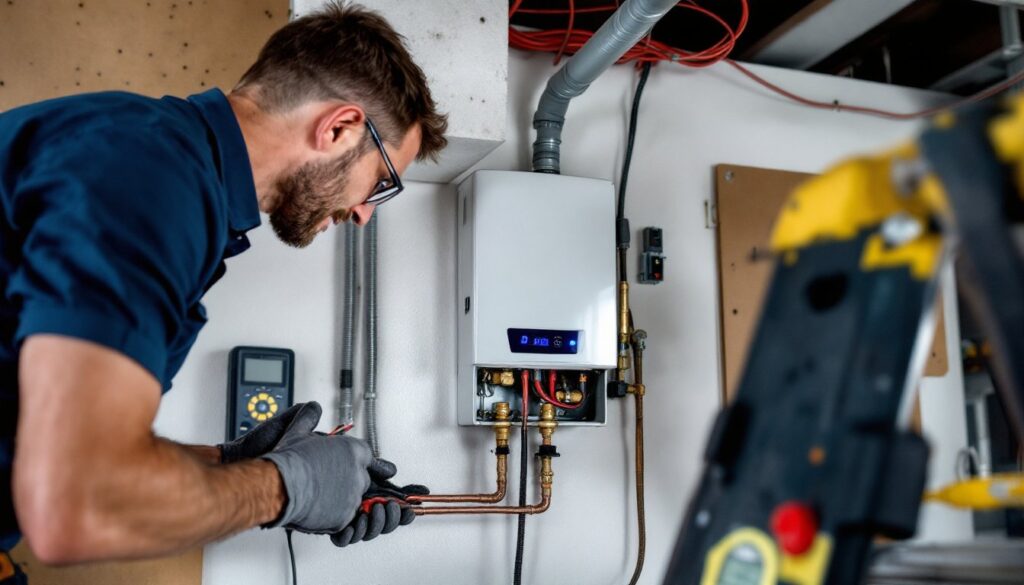
Once the unit is securely mounted, move to the water connections. Electric tankless heaters typically have 3/4-inch NPT threaded inlets and outlets, though some larger units use 1-inch.
Install shut-off valves on both the inlet (cold) and outlet (hot) sides. This makes future service easier. Use ball valves rather than gate valves, they’re more reliable and provide full flow when open.
If using copper pipe, cut to length with a tubing cutter for clean, square cuts. Deburr the inside edge. Apply flux to the pipe and fitting, then solder the joint. Let it cool before moving on. If using PEX, follow the manufacturer’s instructions for the specific connection system (crimp, clamp, or push-fit).
Some installers prefer flexible stainless steel water heater connectors for easier alignment, but verify they’re rated for the operating temperature and pressure of the tankless unit. Cheap connectors can fail.
Install the pressure relief valve (usually on top or side of the unit) per manufacturer specs. Run a discharge tube from the valve to a safe drainage point, terminating 6 inches above a floor drain or outside, per code. This isn’t optional, it’s required by plumbing code and prevents catastrophic overpressure failures.
Turn the water supply back on slowly and check all connections for leaks. Tighten as needed, but don’t over-torque threaded fittings, brass can crack.
Wiring Your Electric Tankless Water Heater Safely
Shut off the main breaker before beginning electrical work. Confirm power is off with a voltage tester at the panel.
Run the appropriately sized wire from the panel to the heater location. Most jurisdictions allow Romex (NM cable) for residential wiring, but some require conduit, especially in unfinished spaces. If using conduit, secure it properly and use correct fittings.
Strip the outer sheathing and individual wire insulation according to the unit’s wiring diagram. Electric tankless heaters use 240-volt circuits, which means two hot wires (typically black and red), a neutral (white), and a ground (bare copper or green).
Some units don’t require a neutral: confirm with your model’s specifications. If the unit doesn’t use neutral, cap it at both ends and leave it in the box for future use.
Connect wires to the unit’s terminal block, matching colors and following the diagram. Tighten terminal screws firmly, loose connections create resistance, heat, and potential fire hazards. When installing systems for quick hot water delivery, proper electrical connections are essential for safety and performance.
At the panel, connect the hot wires to the new double-pole breaker, neutral to the neutral bus bar, and ground to the ground bus bar. In modern panels, neutral and ground bars are separate: in older panels with main breakers, they may be bonded.
Secure the cable with appropriate clamps at both the panel and the unit. Cables should be supported every 4.5 feet along the run per NEC.
Double-check all connections. Replace the panel cover (don’t operate with it off, arc flash hazard). Turn on the main breaker, then the new circuit breaker.
Most electric tankless heaters have indicator lights or digital displays. If the unit powers on and shows no error codes, you’re in good shape. If it doesn’t, shut off the breaker immediately and recheck wiring.
Common Installation Mistakes to Avoid
Undersizing the electrical circuit is the most common error. Some DIYers see “60 amps” and install a 60-amp breaker with 6-gauge wire, ignoring the NEC requirement for circuits to be sized at 125% of continuous load. A unit pulling 60 amps continuously technically needs a 75-amp breaker. Always follow the manufacturer’s specifications and local code.
Using the wrong wire gauge is dangerous. Voltage drop over long runs can reduce performance and create heat. For runs over 100 feet, go up a wire size. Consulting resources like HomeAdvisor can help estimate costs and requirements for professional guidance when needed.
Skipping the pressure relief valve or discharge tube is a recipe for disaster. These devices prevent the unit from becoming a bomb if the thermostat fails.
Mounting the unit in a location that can’t handle the weight or vibration is another issue. Tankless heaters aren’t heavy, but they need solid backing. Drywall anchors alone won’t cut it.
Failing to flush the unit before startup can trap debris in the heat exchanger. Run water through the system for a minute or two before powering the unit on.
Ignoring manufacturer’s clearance requirements can cause overheating or void warranties. Most units need several inches of clearance on all sides for airflow, even though they don’t vent combustion gases like gas models.
Not setting the temperature correctly is a minor but annoying mistake. Most units ship with a default setting around 120°F, which is safe and efficient. Going higher increases energy use and scalding risk without much benefit. For detailed project advice, DIYers often turn to trusted guides from Bob Vila for tips on avoiding common pitfalls.
Finally, attempting this project without a permit where required can lead to fines, failed inspections, and complications when selling the home. If you’re not confident working with high-voltage electrical systems, hire a licensed electrician for the wiring portion. The water connections are straightforward for most DIYers, but the electrical work carries real risk.