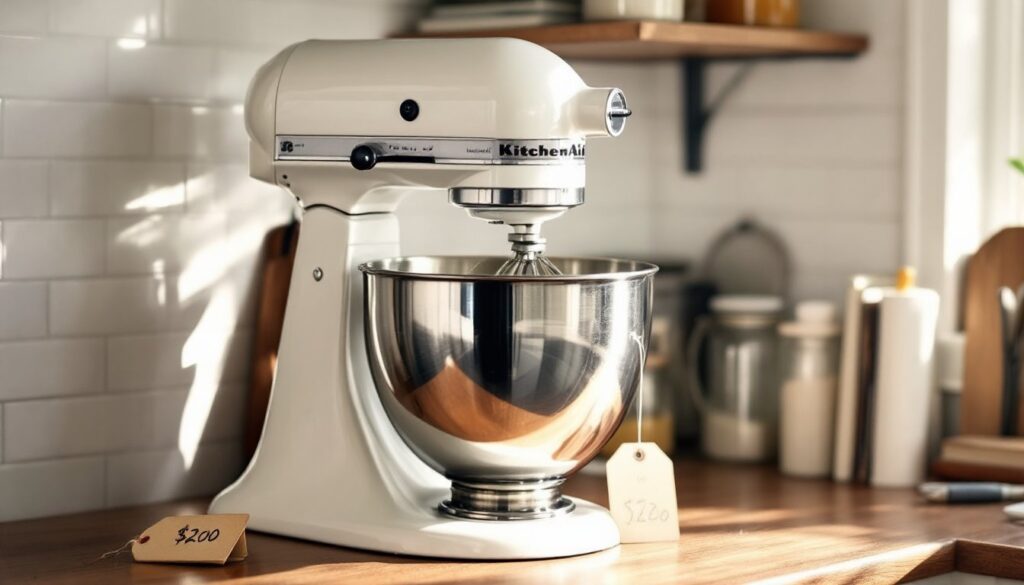
KitchenAid stand mixers are built like tanks, which is exactly why the used market is packed with solid options. A brand-new Artisan or Professional model can run $300 to $700, but a gently used KitchenAid mixer can deliver the same workhorse performance for half the price or less. The catch? You need to know what you’re looking at. A good used mixer will outlast most new appliances: a bad one will burn out mid-cookie batch. This guide walks through where to shop, what to inspect, which warning signs to dodge, and what a fair price actually looks like in 2026.
Table of Contents
ToggleKey Takeaways
- A used KitchenAid mixer typically costs 40–60% less than new while delivering the same durability, with an Artisan retailing for $430 often available for $180–$250.
- Inspect every used KitchenAid mixer thoroughly by testing all speeds, checking the attachment hub, examining the power cord, and running a smell test to catch motor damage before buying.
- Red flags like motor humming without mixing, missing attachments, heavy internal rust, or refusing a test run indicate costly repairs or future failure—always negotiate down or walk away.
- Fair pricing for used models ranges from $100–$180 for Classic models to $250–$400 for Professional 600, with regional adjustments and negotiation room of 10–15% from asking price.
- Buying used extends product life, keeps materials out of waste streams, and may yield older all-metal gear models with better durability than current entry-level units.
- Shop locally on Facebook Marketplace and Craigslist for best deals with in-person inspection, or check eBay and estate sales for rare colors and vintage Hobart-made mixers with exceptional longevity.
Why Buying a Used KitchenAid Mixer Makes Financial Sense
KitchenAid mixers are one of the few countertop appliances that hold resale value and keep running for decades. The motors are direct-drive and metal-geared (in most models), the housings are die-cast metal, and replacement parts are widely available.
A used KitchenAid stand mixer typically costs 40–60% less than new, depending on model and condition. An Artisan that retails for $430 can often be found used for $180–$250. A Professional 600 that lists at $550 might sell used for $275–$350. You’re not sacrificing much, if any, lifespan, especially if the unit was lightly used or sat idle in someone’s pantry for years.
Another advantage: older models (pre-2010) often feature all-metal gears, whereas some newer base models switched to nylon gears in the planetary assembly. If you score a vintage Hobart-era or early 2000s KitchenAid, you may actually get better durability than current entry-level units. That said, even newer mixers with nylon gears are rebuildable and parts run $20–$60 for a full gear set.
The environmental angle matters too. Manufacturing a new stand mixer has a carbon footprint: buying used extends the product’s life and keeps metal and motors out of the waste stream. For DIYers who value resourcefulness, it’s the smart play.
Where to Find the Best Deals on Pre-Owned KitchenAid Mixers
Online Marketplaces and Local Options
The best used KitchenAid mixer for sale deals come from a mix of online platforms and local channels. Each has pros and cons.
Facebook Marketplace and Craigslist are goldmines for local pickups. Sellers often price to move, and you can inspect before buying. Search terms like “KitchenAid mixer used” or “stand mixer” and filter by recent listings. Weekend mornings see the most new posts. Negotiate in person and bring cash for leverage.
eBay offers the widest selection, including rare colors and discontinued Professional models. Use filters for “used” and “local pickup” to avoid shipping damage. Check seller ratings and look for listings with multiple photos showing the mixer running. Avoid auctions unless you set a firm max bid, used Artisans can spiral past $250 in bidding wars.
OfferUp, Mercari, and Poshmark have growing appliance sections. Poshmark tends to run higher due to boutique resellers: Mercari and OfferUp are better for casual sellers offloading after a kitchen remodel.
Estate sales, garage sales, and thrift stores can yield incredible finds, $50 to $100 mixers that just need a cleaning. Bring a smartphone to check model numbers and current resale values on the spot. Goodwill and Habitat for Humanity ReStores occasionally stock kitchenware, though mixers move fast.
Refurbished retailers like KitchenAid’s official outlet or appliance liquidators sell factory-refurbished units with limited warranties. These cost more than peer-to-peer used ($230–$350) but come with some buyer protection. It’s a middle-ground option if you want assurance but not full retail pricing.
For home bakers and DIY enthusiasts who prioritize tested recommendations, resources like Good Housekeeping provide appliance reviews that can help identify which models hold up best over time.
How to Inspect a Used KitchenAid Mixer Before You Buy
Inspection is where you separate a $150 steal from a $150 mistake. Bring a checklist and don’t skip steps, even if the seller seems trustworthy.
1. Check the model and serial number. The sticker is on the underside or back of the motor housing. Cross-reference the model (e.g., KSM150, KP26M1X) online to confirm specs, year, and known issues. Hobart-made models (pre-1986) and early KitchenAid-made units (1986–2000s) are highly sought after.
2. Plug it in and run it through all speeds. Start at speed 1 (stir) and work up to 10. Listen for smooth, consistent humming. Any grinding, squealing, or chattering suggests worn gears or bearings. The mixer should not walk across the counter or vibrate excessively at higher speeds.
3. Attach the flat beater and lift/lower the head or bowl. The tilt-head mechanism should lock firmly: bowl-lift models should raise and lower without sticking. Check that the beater clears the bowl by about 1/8 inch at the lowest point, this is the beater-to-bowl clearance. Too much gap means poor mixing: too little means the beater will scrape or stall.
4. Inspect the attachment hub. Remove the hub cover and check the pin inside. It should be intact, not sheared or worn down. Try attaching and removing an accessory if you have one (or ask the seller to demo). The hub should hold attachments snugly without wobble.
5. Examine the power cord and plug. Look for fraying, cracks, or exposed wire. A damaged cord is a safety hazard and costs $25–$40 to replace (plus labor if you’re not comfortable with electrical work).
6. Check the cosmetics. Scratches and dings are normal and don’t affect function, but deep cracks in the housing or a heavily rusted bowl indicate neglect. Surface rust on beaters can be scrubbed off: pitting means replacement.
7. Smell test. Run the mixer for 30 seconds and sniff near the motor vents. A burning or acrid smell suggests overheating or fried windings. Walk away from anything that smells like burnt plastic or electrical char.
For more guidance on kitchen organization and appliance care, consider checking out dedicated kitchen resources that test and review stand mixer performance.
Red Flags to Watch Out for When Shopping Used
Some issues are repairable: others mean the mixer is on borrowed time. Here’s what should make you pause or pass.
Motor runs but won’t mix. If the motor hums but the beater doesn’t turn, the worm gear or planetary assembly is likely stripped. This is fixable ($30–$60 in parts, 1–2 hours of work) but adds to your total cost. Negotiate down by at least $50–$75 if you’re willing to DIY the repair.
Speed control doesn’t work or speeds are erratic. The speed control plate (a circuit board on newer models or a mechanical governor on older ones) may be faulty. Replacement parts run $40–$80, and installation requires some disassembly. Not a dealbreaker, but factor it into your offer.
Bowl or beaters missing. Replacement stainless bowls cost $50–$90: beaters run $15–$35 each. If the seller has no attachments, calculate those costs before committing. A mixer-only deal should be priced accordingly.
Heavy rust, especially inside the gear case. Surface rust is cosmetic. Rust inside the housing or on internal gears means the mixer was stored in a damp environment and may have corrosion throughout. Pass unless you’re buying for parts.
No test run allowed. If a seller won’t plug it in, assume it doesn’t work. “I don’t have room to demo it” or “it worked last time I used it” are not acceptable. Walk away.
Seller can’t explain why they’re selling. “Upgrading” or “moving and downsizing” are reasonable. Vague answers or defensive behavior suggest they know there’s a problem.
Price is suspiciously low. A fully functional Artisan listed at $75 is either stolen, broken, or the seller doesn’t know what they have. Proceed with caution and inspect thoroughly. For home project enthusiasts who want reliable, long-lasting tools, Martha Stewart offers advice on appliance maintenance and longevity.
Pricing Guide: What You Should Actually Pay
Used KitchenAid mixer prices vary by model, condition, and region. As of 2026, here’s what fair market looks like.
KitchenAid Artisan (KSM150, KSM160): $150–$250 for good condition with bowl and at least one beater. $120–$180 if cosmetically rough but functional. $200–$280 if near-mint or includes extra attachments (dough hook, whisk, pouring shield).
KitchenAid Classic (KSM75, KSM90): $100–$180. The Classic has a smaller 4.5-quart bowl and less powerful motor, so it’s priced lower. Avoid paying over $200 unless it’s brand-new in box.
KitchenAid Professional 5 Plus (KV25): $180–$280. Bowl-lift design, 5-quart capacity, 450-watt motor. A workhorse model that handles bread dough and dense batters without bogging down.
KitchenAid Professional 600 (KP26M1X): $250–$400. The 6-quart, 575-watt commercial-style mixer. Highly sought after by serious bakers. Expect to pay near the high end for low-hours units.
Vintage Hobart-made mixers (pre-1986): $150–$500+, depending on model and condition. K45 models run $100–$200: classic K5-A mixers can hit $300–$500 if fully restored. Collectors pay premium for these.
Condition adjustments: Deduct $30–$50 for missing attachments. Deduct $40–$75 if repairs are needed (gears, speed control). Add $20–$40 for rare colors (pistachio, aqua sky, limited editions).
Regional variance: Prices run 10–20% higher in metro areas (NYC, SF, Seattle) and 10–20% lower in rural markets. Shipping adds $25–$50 and increases the risk of damage, so local pickup is preferred.
Negotiation room: Most sellers will drop 10–15% from asking price, especially if you’re buying same-day with cash. Point out any cosmetic flaws or missing parts to justify your counteroffer.
Conclusion
A quality used KitchenAid stand mixer is one of the best values in the secondhand appliance market, if you know how to shop for one. Stick to reputable sources, run a thorough in-person inspection, watch for red flags like motor noise or rust, and price according to model and condition. With a little patience and diligence, a $200 investment can deliver decades of reliable mixing, kneading, and whipping. That’s a return even the best new appliance can’t match.