Growing plants indoors used to mean stretching them toward a dim windowsill and hoping for the best. Today, full spectrum LED grow lights give indoor gardeners control over light quality, intensity, and duration, without the heat and energy waste of older bulb technologies. Whether someone’s nurturing seedlings in a basement, maintaining a kitchen herb wall, or filling a spare bedroom with tropicals, choosing the right grow light makes the difference between leggy, pale foliage and robust, healthy growth. This guide walks through what full spectrum LEDs actually deliver, how they stack up against older options, and how to select and install a system that works for any indoor growing space.
Table of Contents
ToggleKey Takeaways
- Full spectrum LED grow lights emit wavelengths across the entire visible light range to mimic natural sunlight, eliminating the need to swap fixtures as indoor plants move through different growth stages.
- Full spectrum LEDs are 50–60% energy efficient compared to 20–40% for traditional fluorescent and HID bulbs, cutting electricity costs by 60% or more while running cool enough to mount just 12–18 inches above plant canopies.
- Select full spectrum LED grow lights based on actual wattage draw and PAR output (measured in μmol/m²/s) rather than marketing claims, with seedlings requiring 20–30 watts per square foot and high-light plants needing 40–50+ watts per square foot.
- Mounting your LED system safely requires a dedicated circuit for loads over 500 watts, GFCI protection in damp areas, secure overhead installation on joists rather than drywall, and a timer set for 12–16 hours of light daily.
- Quality full spectrum LED fixtures last 50,000+ hours (10–12 years), offer spectral tuning with adjustable red and blue channels, and contain no mercury or fragile components, making them safer and more durable than older grow light technologies.
What Are Full Spectrum LED Grow Lights and Why Do Indoor Plants Need Them?
Full spectrum LED grow lights emit wavelengths across the entire visible light range, roughly 380 to 740 nanometers, mimicking natural sunlight. Unlike older fluorescent or HID (high-intensity discharge) lamps that concentrate output in narrow bands, modern full spectrum LEDs deliver balanced red, blue, green, and far-red wavelengths that plants use for photosynthesis, stem development, flowering, and fruiting.
Indoor plants need this broad spectrum because different growth stages demand different wavelengths. Blue light (400–500 nm) drives vegetative growth and compact foliage. Red light (600–700 nm) triggers flowering and fruiting. Green wavelengths, once dismissed, penetrate deeper into the canopy and support overall photosynthesis. Far-red light (700–740 nm) influences shade avoidance and flowering timing. A full spectrum grow light covers all these bases, so growers don’t need to swap fixtures as plants mature.
Without adequate light indoors, plants stretch toward the nearest window, develop thin stems, produce pale leaves, and often fail to flower. Standard household LED bulbs, even daylight-rated ones, lack the intensity and spectral balance plants require. Full spectrum grow lights solve this by delivering photosynthetically active radiation (PAR) in the wavelengths plants actually absorb, measured in micromoles per square meter per second (μmol/m²/s).
Key Benefits of Using Full Spectrum LEDs Over Traditional Grow Lights
Energy efficiency tops the list. Full spectrum LEDs convert roughly 50–60% of electrical input into usable light, compared to 30–40% for fluorescent tubes and 20–30% for HID bulbs. A 100-watt LED panel can replace a 250-watt metal halide or high-pressure sodium lamp, cutting electricity costs by 60% or more. Over a growing season, that translates to real savings on the power bill.
Heat management is another major advantage. Older grow lights, especially HID systems, generate intense heat that requires exhaust fans, ducting, and sometimes air conditioning. LEDs run cool enough to mount within 12–18 inches of plant canopies without scorching foliage. This lets growers use closets, cabinets, and small rooms without installing ventilation infrastructure.
Lifespan is significantly longer. Quality full spectrum LEDs are rated for 50,000 hours or more, roughly 10–12 years of daily use at 12 hours per day. Fluorescent tubes need replacement every 10,000–20,000 hours, and HID bulbs degrade noticeably after 10,000 hours. The upfront cost of LEDs is higher, but replacement frequency is a fraction of older technologies.
Spectral tuning gives growers precision. Many LED fixtures allow dimming or independent control of red and blue channels, so users can tailor light recipes to specific plants or growth phases. Seedlings get more blue: flowering tomatoes get more red. This flexibility is impossible with fixed-spectrum fluorescent or HID lamps.
Finally, safety and durability matter. LEDs contain no mercury (unlike CFLs and fluorescents), produce minimal UV radiation, and have solid-state construction that resists breakage. There’s no fragile glass envelope or pressurized arc tube to shatter.
How to Choose the Right Full Spectrum LED Grow Light for Your Space
Selecting a grow light starts with understanding the space and the plants. A 2×2-foot seedling shelf has different needs than a 4×8-foot grow tent full of mature peppers.
Wattage and Coverage Area Requirements
Wattage correlates loosely with light output, but it’s not the whole story. Manufacturers often list “actual draw” (the real power consumption) and “equivalent wattage” (the HID wattage they claim to replace). Ignore the equivalent number, it’s marketing. Focus on actual draw and PAR output.
As a rough guideline:
- Seedlings and low-light plants (lettuce, herbs, foliage houseplants): 20–30 watts per square foot of canopy, delivering 200–400 μmol/m²/s PAR.
- Medium-light plants (tomatoes, peppers, most vegetables): 30–40 watts per square foot, delivering 400–600 μmol/m²/s.
- High-light plants (cannabis, fruiting tropicals, sun-loving flowers): 40–50+ watts per square foot, delivering 600–1,000+ μmol/m²/s.
Coverage area shrinks as light intensity increases. A 150-watt panel might cover 4×4 feet for seedlings but only 2×2 feet for flowering tomatoes. Check the manufacturer’s PAR map, a chart showing light intensity at various distances and grid positions. Quality fixtures publish these: budget lights often don’t.
Mounting height affects both coverage and intensity. Most full spectrum LEDs perform best mounted 12–24 inches above the canopy. Closer increases intensity but narrows coverage: farther reduces intensity but spreads light more evenly. Adjustable hangers or pulley systems (like those used for shop lights) make height tuning easy.
Understanding Light Spectrum and PAR Values
PAR (photosynthetically active radiation) measures light in the 400–700 nm range that drives photosynthesis. It’s expressed in μmol/m²/s and tells you how much usable light hits the plant. A fixture might claim 1,000 watts, but if PAR at canopy height is only 150 μmol/m²/s, it won’t support vigorous growth.
Look for fixtures that publish PPFD (photosynthetic photon flux density) maps, these show PAR readings across the coverage area at specific heights. A good fixture delivers uniform PPFD with minimal hot spots or dead zones. Avoid lights that only list total PPF (photosynthetic photon flux) without spatial distribution data.
Spectrum balance varies by fixture. Many hobbyists appreciate resources from gardening authorities like Gardenista for plant care context, but the technical side matters here. Look for lights with:
- 20–30% blue (promotes compact, bushy growth)
- 50–60% red (drives photosynthesis and flowering)
- 10–20% green (penetrates canopy, supports overall health)
- Optional far-red (accelerates flowering in some species)
Some fixtures add white LEDs (which contain a broad mix) alongside red and blue diodes. This produces a more natural appearance and better color rendering, making it easier to spot pests, deficiencies, or disease. Pure blurple (blue-purple) lights work fine but make visual inspection harder.
Color temperature is less critical for plants than for human eyes, but many growers prefer 3,000–5,000K fixtures because they render foliage colors accurately and don’t turn the grow room into a purple cave.
Setting Up Your Full Spectrum LED Grow Light System at Home
Installation is straightforward, but attention to electrical safety, mounting, and timing makes the difference between a reliable setup and a fire hazard.
Electrical requirements: Most residential LED grow lights run on standard 120V AC and draw 50–300 watts. Check the fixture’s amperage, most fit comfortably on a 15-amp circuit, but running multiple lights alongside other appliances can trip breakers. Use a dedicated circuit if running more than 500 watts of lighting. If installing in a damp basement or garage, GFCI protection is required per NEC (National Electrical Code) Article 210.8. Plug fixtures into grounded outlets only: avoid daisy-chaining power strips.
Mounting options depend on the space:
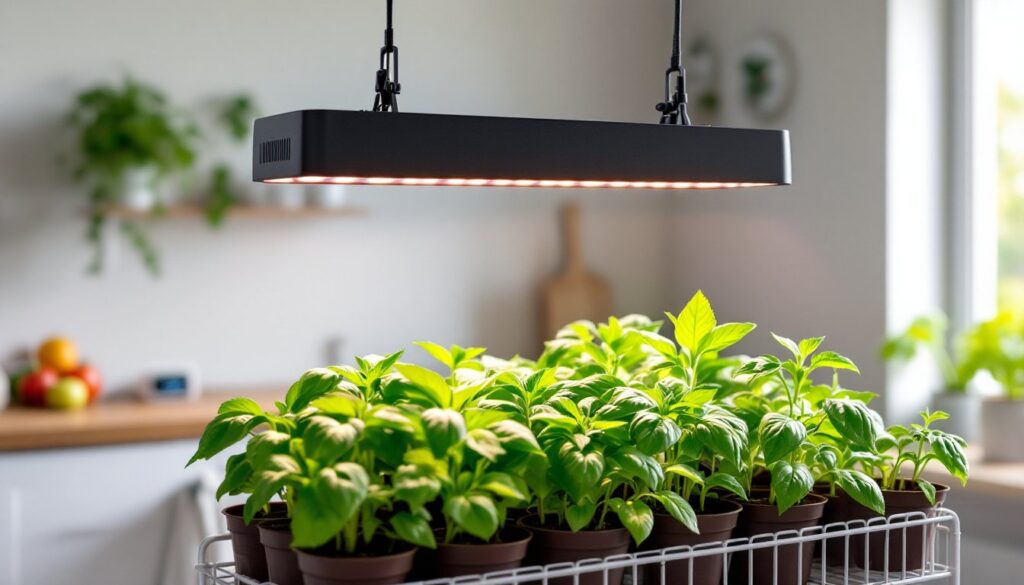
- Wire shelving units: Use S-hooks or adjustable ratchet hangers to suspend panel lights from the shelf above. Leave 12–18 inches between light and plant tops: adjust as plants grow.
- Grow tents: Most tents include a cross-bar rated for 50+ pounds. Hang lights with ratchet hangers or rope ratchets for easy height adjustment.
- Overhead mounting (basement joists, ceiling studs): Use eye hooks screwed into joists (not drywall anchors, grow lights weigh 5–20 pounds and vibrate slightly from internal fans). For permanent installations, consider low-voltage cable hanging kits designed for shop lights.
Ventilation and clearance: Even cool-running LEDs need airflow. Ensure at least 6 inches of clearance above the fixture for heat dissipation. Built-in fans should run quietly: if they’re loud, the bearings may be cheap or failing. In enclosed spaces like cabinets, add a small clip fan to circulate air and prevent hot spots.
Timers are essential. Most plants need 12–16 hours of light per day, depending on species and growth stage. A mechanical or digital timer (rated for the fixture’s wattage) automates the cycle and prevents human error. For precision, use a digital timer with battery backup so power outages don’t reset the schedule. Many home improvement sites, including those offering comprehensive home improvement how-tos, recommend timers as a baseline tool for any indoor garden.
Safety checklist before first power-on:
- Confirm the fixture is rated for the mounting method (chain, wire, or overhead support).
- Verify the outlet is grounded and on a circuit with adequate capacity.
- Inspect the power cord for damage: replace if frayed or cracked.
- Ensure the fixture is level and secure, falling lights can injure people and destroy plants.
- Test the timer cycle before leaving plants unattended.
Ongoing adjustments: As seedlings grow, raise the light to maintain 12–18 inches of clearance. For taller plants like tomatoes or peppers, consider side-mounted supplemental lights to illuminate lower canopy. Monitor leaf color and growth rate, pale, stretched growth means insufficient light: curled or bleached leaves suggest too much intensity or heat stress.
PPE note: Wear UV-blocking safety glasses if the fixture emits UV wavelengths (some specialized models do). Direct exposure to high-intensity LEDs can cause eye strain or temporary vision changes, though most consumer fixtures pose minimal risk.
Conclusion
Full spectrum LED grow lights have turned basements, spare rooms, and kitchen counters into productive growing spaces. By matching light quality and intensity to plant needs, adjusting for coverage and wattage, and installing fixtures safely, anyone can maintain healthy indoor gardens year-round. The upfront investment pays off in lower energy bills, longer fixture life, and plants that actually thrive instead of just survive.