Hard water leaves stubborn mineral deposits on fixtures, ruins appliances, and makes soap barely lather. If white scale is building up around your faucets and your water heater is working overtime, a water softener isn’t a luxury, it’s preventive maintenance. Pentair, a trusted name in water treatment since the 1960s, manufactures salt-based and salt-free systems designed for residential use. This guide walks through Pentair’s current lineup, installation considerations, and the routine care that keeps these systems delivering soft water year after year.
Table of Contents
ToggleKey Takeaways
- A Pentair water softener uses ion-exchange technology to remove calcium and magnesium minerals through resin beads charged with sodium ions, requiring periodic salt regeneration to maintain effectiveness.
- Popular models like the Fleck 5600SXT and WaterBoss 700 offer metered regeneration that conserves salt and water by responding to actual usage rather than running on fixed schedules.
- DIY installation is achievable for homeowners with basic plumbing skills, though galvanized steel main lines and complex drain setups may require a licensed professional ($200–$500).
- Monthly salt checks, semi-annual resin cleaning, and annual brine valve inspections are essential maintenance tasks that prevent salt bridges, resin fouling, and system inefficiency.
- Pentair water softener units are NSF/ANSI 44 certified and include bypass valves for safety, making them reliable for households with 1.5 to 2.5+ bathrooms depending on model capacity.
What Is a Pentair Water Softener and How Does It Work?
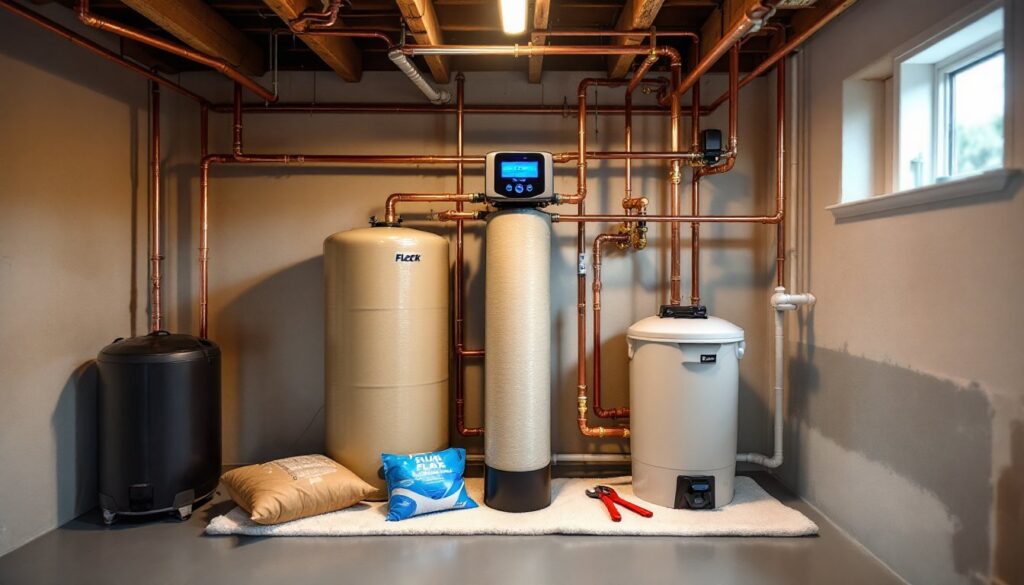
A Pentair water softener is an ion-exchange appliance that removes calcium and magnesium ions, the minerals that cause hardness, from household water. The system consists of a resin tank filled with polymer beads charged with sodium ions, a brine tank that holds salt pellets, and a control valve that automates regeneration cycles.
When hard water flows through the resin tank, calcium and magnesium ions cling to the beads while sodium ions release into the water. Once the resin becomes saturated with hardness minerals, the control valve triggers regeneration: concentrated salt brine flushes the resin, displacing the calcium and magnesium down the drain and recharging the beads with fresh sodium.
Salt-based vs. salt-free: Pentair’s traditional softeners use salt for ion exchange, delivering true softening measured in grains per gallon (gpg) removed. Salt-free conditioners, sometimes marketed under the Pentair umbrella, use template-assisted crystallization (TAC) to alter mineral structure, reducing scale without removing hardness. TAC systems require no electricity or backwash, but they won’t give you the slippery feel or improved soap lather that ion exchange provides.
Most Pentair residential models handle water hardness from 10 to 110 gpg and household flow rates up to 12 gallons per minute (gpm). Sizing depends on peak demand, count simultaneous fixture use (shower, washing machine, dishwasher) and daily water consumption.
Top Pentair Water Softener Models for Homeowners
Pentair’s residential lineup includes several configurations tailored to household size and water chemistry. Leading models feature water softener systems that vary in capacity and automation level.
Pentair Fleck 5600SXT: One of the most popular DIY-friendly units, the Fleck 5600SXT uses a digital metered valve that regenerates based on actual water use rather than a timer. Available in capacities from 32,000 to 80,000 grains, it suits households of two to six people. The backlit LCD display shows days to regeneration, current time, and salt level. Expect around 45 pounds of resin in a 10-inch diameter tank and a brine tank that holds up to two 40-pound bags of salt. Flow rate: 12 gpm service, adequate for homes with 1.5 to 2.5 bathrooms.
Pentair Fleck 7000SXT: A step up in capacity, the 7000SXT handles 64,000 to 96,000 grains and delivers up to 16 gpm, better for larger homes (three-plus bathrooms) or households with very hard water (above 75 gpg). The valve features similar metered regeneration and a touchpad interface. Resin tank diameter increases to 12 or 13 inches.
Pentair WaterBoss 700 and 900: Compact, single-tank designs that combine the resin and brine compartments into one cabinet. The WaterBoss 700 (70 gpg max, 36,400 grain capacity) regenerates in about 19 minutes using a high-flow backwash, making it suitable for homes with limited space or on well water with moderate iron (up to 10 ppm). The 900 model scales to 90 gpg and 36,400 grains. Both regenerate on demand and include built-in sediment filtration. Trade-off: Faster regeneration means higher water use per cycle (14–16 gallons) compared to larger Fleck models.
Third-party reviews on leading water softener guides consistently rate Fleck valves for reliability and user-serviceable parts.
Key Features That Make Pentair Stand Out
Metered regeneration: Pentair’s Fleck SXT valves monitor water flow with a turbine meter, initiating regeneration only when a preset volume has passed through the resin. This conserves salt and water compared to timed systems that regenerate on a fixed schedule regardless of actual use.
User-serviceable valves: Fleck valves use modular seals and pistons available as rebuild kits. A homeowner comfortable with basic plumbing can replace a brine valve, bypass assembly, or drive motor without replacing the entire control head. Detailed schematics and part numbers are published in the installation manual.
Iron removal capability: Several Pentair models, especially the WaterBoss line, include an oxidizing filter or extended backwash cycle to handle ferrous (clear-water) iron up to 10 ppm. For higher iron, add a dedicated iron filter upstream or specify a unit with a fine-mesh resin. Caution: Ferric (red-water) iron fouls resin quickly: pretreat with a sediment filter if visible rust is present.
NSF/ANSI 44 certification: Pentair softeners meet NSF Standard 44 for performance claims and material safety. This third-party certification verifies the system reduces hardness to the stated level without leaching contaminants. Look for the NSF mark on the data plate.
Bypass valve and safety shutoff: All residential Pentair units include a three-valve bypass (two isolation valves and one bypass) for service or emergencies. High-end models add a flow sensor that halts operation if a downstream leak exceeds the programmed threshold, helpful for preventing water damage if a line ruptures during regeneration.
Installing Your Pentair Water Softener: DIY vs. Professional
Permits and codes: Most jurisdictions classify water softener installation as minor plumbing, exempt from permits if you’re not altering the main service line or adding new drain connections. Always check local codes. The International Plumbing Code (IPC) requires an air gap or backflow preventer on the drain line to prevent contaminated water from siphoning back into the softener. Some municipalities mandate a loop or stub-out at the water heater for future softener installation, if yours has one, installation is simpler.
DIY considerations: Installing a Pentair softener is within reach for a homeowner with basic plumbing skills and the right tools. You’ll need:
• Pipe cutter or hacksaw for cutting copper or PEX supply lines
• Adjustable wrenches (10-inch and 12-inch)
• Teflon tape and pipe dope for threaded connections
• Tubing cutter for the ¾-inch drain line
• Level and tape measure
Key steps:
- Locate the softener near the main water line after the pressure tank (if on well water) but before the water heater. Leave 10 inches of clearance behind the unit for service access and at least 3 feet in front for salt loading.
- Install a bypass loop using the included yoke fittings (typically 1-inch NPT) or SharkBite push-fit connectors if working with PEX or copper. Cut the main supply line and attach inlet/outlet ports. Tip: Use a pipe cutter for clean, square cuts, hacksaw burrs can catch debris and foul the resin.
- Run the drain line to a utility sink, standpipe, or floor drain. Use ½-inch or ¾-inch rigid tubing and maintain a downward slope (¼ inch per foot minimum). The drain must be able to handle 5–8 gpm during backwash. Install an air gap fitting if the drain line terminates below the flood rim of a sink or within 1 inch of standing water.
- Connect the brine line (small flexible tubing) from the control valve to the float assembly inside the brine tank. This line refills the salt reservoir after each regeneration.
- Plug in the transformer to a 120V GFCI-protected outlet. The NEC requires GFCI protection in utility rooms and unfinished basements.
When to call a pro: If your main line is galvanized steel, you’ll need a plumber to cut and thread pipe or transition to PEX. Homes without an existing loop, floor drain, or accessible outlet may require running new circuits or drain lines, jobs that often need a licensed contractor. Professional installation typically costs $200–$500 depending on complexity, and some municipalities require a licensed plumber for any work on the main supply.
Maintenance Tips to Keep Your System Running Smoothly
Salt management: Check the brine tank monthly. Keep the salt level at least one-quarter full but not higher than the waterline marked inside the tank. Use solar salt pellets or evaporated salt (99.6% pure): avoid rock salt, which leaves sediment. If the salt forms a crusty bridge above the water, called a salt bridge, break it with a broom handle to restore brine flow.
Resin bed cleaning: Every six months, add resin cleaner (available as Iron Out or Pro Products Rust Out) to the brine tank before a regeneration cycle. This dissolves iron, manganese, and organic buildup that reduces exchange capacity. Follow package directions, typically 4–8 ounces per cleaning. Homes with high iron or chlorinated municipal water may need quarterly cleaning.
Inspect the brine valve and injector: Once a year, remove the control valve cover (unplug first) and check the venturi injector, a small nozzle and screen assembly that draws brine into the resin tank. Sediment clogs the screen, reducing suction and leaving resin unsoftened. Clean with a toothbrush and vinegar. Examine the brine valve float inside the tank: if it sticks, regeneration cycles won’t refill properly.
Bypass and sanitize during extended absence: If leaving home for more than two weeks, set the softener to bypass mode to prevent stagnant water in the resin tank. Upon return, run a manual regeneration cycle and flush cold taps for two minutes to clear any biofilm.
Water testing: Test your raw hardness (before the softener) and treated hardness (after) every three months using a drop test kit or digital meter. Treated water should measure 0–1 gpg. If hardness creeps above 3 gpg, the resin may be fouled or exhausted, or the control valve settings may need adjustment. Many experts in water softener comparisons recommend annual professional water analysis, especially for well water.
Common Issues and Troubleshooting Solutions
Salt bridges and mushing: A salt bridge occurs when humidity causes the top layer of salt to harden into a crust, leaving an air gap below. The brine tank looks full, but no salt dissolves into the water. Solution: Break the bridge and remove loose chunks. Salt mushing, thick sludge at the tank bottom, happens with high humidity or poor-quality salt. Scoop out the mush, clean the tank, and refill with high-purity pellets.
Continuous running or water in the bypass: If water discharges to the drain continuously, the control valve may be stuck in regeneration. Check for:
• Debris lodged in the valve piston, remove the valve cap and inspect the spacer stack.
• Failed drive motor or timer, listen for the motor hum during a manual cycle.
• Plugged drain line restricting backwash, disconnect and flush.
Water leaking from the bypass usually means a worn O-ring or loose clip. Replacement O-ring kits cost under $15 and install in minutes.
Low water pressure: Softeners add minimal pressure drop (2–4 psi) when clean. If pressure drops suddenly:
• Check that the bypass is in the service position, not halfway open.
• Inspect the inlet screen (if equipped) for sediment.
• Confirm the resin hasn’t channeled, irregular flow paths that reduce contact time. Backwash the resin with a manual cycle.
Error codes: Fleck SXT valves display error messages on the LCD:
• Err 1 or Err 2: Motor jam or obstruction, cycle the valve manually by advancing the regeneration dial.
• Low battery warning: Replace the 9V backup battery (located behind the faceplate) to preserve programming during power outages.
Iron staining persists: If rust stains return even though softener operation, test for ferric iron. Pentair softeners handle up to 3 ppm ferrous iron: higher levels or ferric iron require a dedicated oxidizing filter upstream.
Conclusion
A Pentair water softener is a solid investment for homes battling hard water, combining proven ion-exchange technology with user-friendly controls. Whether choosing a compact WaterBoss for a condo or a high-capacity Fleck 7000SXT for a busy household, proper sizing and consistent maintenance deliver years of scale-free plumbing and appliances that last longer. Install it right, keep salt stocked, and clean the resin annually, your water heater and your shower doors will thank you.