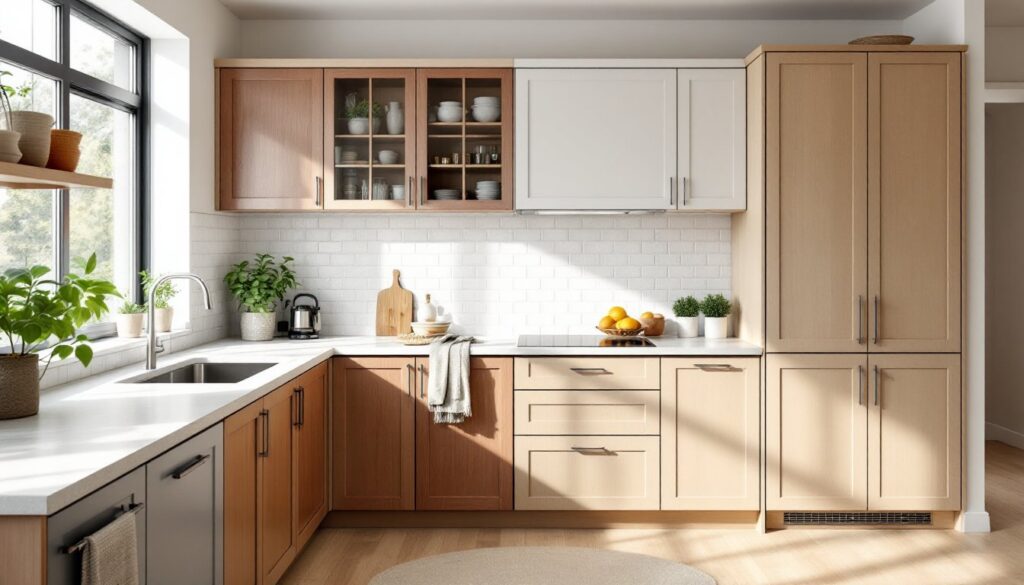
Walk into any home center, and the cabinet aisle can feel overwhelming. Dozens of door styles, finishes, and construction methods, all promising the perfect kitchen. But choosing the right type of kitchen cabinets isn’t about trends or aesthetics alone. It’s about understanding how cabinets are built, what materials hold up to daily use, and which functional designs actually make cooking and cleanup easier. This guide breaks down the different styles of kitchen cabinets by construction, door design, materials, and purpose, so you can make an well-informed choice that fits both your budget and your workflow.
Table of Contents
ToggleKey Takeaways
- Types of kitchen cabinets differ fundamentally by construction—framed cabinets sacrifice 1-2 inches of space but are forgiving for DIY installation, while frameless designs offer 10-15% more storage but require precise wall alignment.
- Shaker doors are the most versatile door style for kitchen cabinets, working across farmhouse, transitional, and modern aesthetics while remaining affordable and easy to paint.
- Plywood boxes paired with hardwood face frames and doors provide the best balance of durability and cost-effectiveness for kitchen cabinet systems.
- Functional cabinet types—base, wall, tall, and specialty—solve different storage challenges; drawer-based cabinets cost 30-50% more but offer superior access compared to traditional shelved designs.
- Material selection significantly impacts maintenance and longevity: MDF excels for painted finishes but swells near moisture, while solid hardwood costs $2,000-$5,000 more but can be refinished if damaged.
- Proper installation planning—including filler strips, stud location verification, and wall shimming—prevents misalignment and ensures doors operate smoothly for years.
Understanding Cabinet Construction Styles
Before you pick a door style or finish, you need to understand the box itself. Cabinet construction determines how much weight your shelves can hold, how doors align over time, and whether you’ll deal with sagging hinges five years down the road. The two dominant types of cabinets for kitchen installations are framed and frameless, and the difference goes deeper than looks.
Framed Cabinets
Framed cabinets feature a 1½-inch face frame made from solid wood attached to the front of the cabinet box. This frame adds structural rigidity and provides a mounting surface for hinges and doors. It’s the traditional American style, dating back to when cabinetmakers used thinner plywood or particleboard and needed that front frame for strength.
The frame does reduce the cabinet opening slightly, about 1 to 2 inches of usable width, but it allows for partial-overlay, full-overlay, or inset door styles. Partial-overlay doors cover only part of the frame, leaving some wood visible. Full-overlay doors cover most of the frame. Inset doors sit flush inside the frame, requiring precise joinery and typically costing 15–30% more due to tighter tolerances.
Framed construction is forgiving during installation. If your walls aren’t perfectly plumb, you can shim and adjust without visible gaps. It’s the go-to for DIY remodels and most stock or semi-custom cabinets at big-box stores.
Frameless Cabinets
Frameless cabinets (sometimes called European-style or full-access cabinets) eliminate the face frame entirely. Doors mount directly to the cabinet box using hidden hinges, and the box itself is made from thicker material, typically ¾-inch plywood or MDF, to handle the load.
Without a frame in the way, you gain about 10–15% more interior space. Pull out a drawer, and it clears the opening entirely, making frameless designs popular in modern and minimalist kitchens where clean lines and maximum storage matter.
The trade-off? Frameless cabinets require more precise installation. Your walls, floor, and ceiling need to be level, or doors won’t align properly. Also, the hinge hardware is more expensive, and repairs are trickier if the particleboard core strips out. If you’re tackling a DIY kitchen, frameless cabinets demand tighter measuring and careful shimming, don’t skip the laser level.
Popular Cabinet Door Styles for Every Design Aesthetic
The door is the face of your cabinet, and the single biggest driver of visual style. But door choice isn’t just cosmetic. Panel construction affects durability, maintenance, and how well paint or stain adheres over time. Here’s a rundown of the most common door styles you’ll encounter when shopping for different styles of kitchen cabinets.
Shaker doors are the workhorse of kitchen design. A five-piece door with a flat center panel and a simple recessed frame, Shaker style works in farmhouse, transitional, and modern kitchens. It’s easy to paint, easy to clean, and usually mid-priced. If you’re planning to DIY or want flexibility to repaint later, Shaker’s your baseline.
Flat-panel (slab) doors are a single piece of material, MDF, plywood, or thermofoil. No rails, no stiles, no joinery. This is the cleanest look for contemporary or Scandinavian-style kitchens. The catch? Every fingerprint shows, especially on high-gloss finishes. If you’ve got kids or cook often, plan to wipe these down daily.
Raised-panel doors feature a center panel that projects outward from the frame. These are traditional, formal, and often found in cherry or maple with a stain finish. They’re more expensive due to the machining involved and can collect dust and grease in the panel edges, factor in extra cleaning time.
Beadboard or cottage-style doors have vertical grooves (beads) running across the panel. They’re lighter in feel than raised panels and pair well with white or pastel paint. Just know that those grooves trap grime, so a degreaser and a small brush will become part of your routine.
Glass-front doors (with mullions or without) let you display dishware or break up a wall of solid cabinets. They work in upper cabinets but require you to keep the interior organized, nobody wants to see a stack of mismatched Tupperware. Use tempered glass if you’re installing these yourself: it’s safer if something heavy shifts on the shelf.
Designers at The Kitchn often emphasize mixing door styles, Shaker lowers with glass uppers, for instance, to add visual interest without chaos. Just keep hardware and finish consistent, or it’ll look like a parts bin rather than a design choice.
Cabinet Materials: Comparing Durability and Cost
The material inside your cabinet box and behind that door is where your budget either stretches or blows up. Not all wood is created equal, and not all composite materials are junk. Here’s what you’ll actually encounter at the lumberyard or in a cabinet showroom.
Solid hardwood (maple, oak, cherry, hickory) is the gold standard for face frames, doors, and drawer fronts. It’s strong, takes stain beautifully, and can be sanded and refinished if scratched. Cabinet-grade hardwood runs roughly $8–$15 per board foot depending on species and grade. For a full kitchen, expect hardwood doors and frames to add $2,000–$5,000 to your cost compared to MDF or particleboard alternatives.
Plywood is the backbone of quality cabinet boxes. It’s made from thin layers of wood veneer glued in cross-grain, giving it excellent screw-holding power and resistance to warping. Look for cabinet-grade plywood (usually birch or maple veneer) with a smooth A or B face. Standard ¾-inch plywood costs around $50–$75 per 4×8 sheet. Avoid construction-grade CDX, it’s not smooth or stable enough for cabinetry.
Medium-Density Fiberboard (MDF) is wood fiber and resin pressed into dense, flat panels. It’s heavier than plywood, cuts cleanly, and takes paint like a dream, no grain to raise, no knots to fill. MDF doors are common in painted cabinets and cost 20–40% less than solid wood. The downside? MDF swells if it gets wet, so avoid it near sinks or dishwashers unless it’s sealed properly. And wear a respirator when cutting MDF, the dust is superfine and nasty.
Particleboard is the budget option: wood chips and glue pressed into sheets. It’s fine for cabinet boxes in dry locations, but it won’t hold screws as well as plywood, and it crumbles if you over-tighten hardware. Most stock cabinets at big-box stores use particleboard boxes with hardwood or MDF doors. If you’re buying particleboard cabinets, make sure edges are sealed or laminated to keep out moisture.
Thermofoil is a vinyl film heat-pressed onto MDF. It’s smooth, wipeable, and comes in dozens of colors and faux-wood grains. The upside? Low cost and zero painting required. The downside? Heat from dishwashers or improper pot placement can cause the film to peel. Thermofoil cabinets work well for rental properties or budget remodels, but they’re not repairable if damaged.
For a balanced approach, many pros recommend plywood boxes with hardwood face frames and doors. This combo offers durability where it counts and keeps costs reasonable. According to experts at Remodelista, mixing materials strategically is how quality cabinetmakers hit a price point without sacrificing longevity.
Functional Cabinet Types by Purpose
Beyond looks and materials, cabinets are defined by where they go and what they do. Choosing the right functional cabinet types can turn wasted space into serious storage and make your kitchen layout work harder. Here’s what you need to know about the workhorses of kitchen storage.
Base cabinets sit on the floor and typically measure 34½ inches tall (36 inches with countertop), with depths of 24 inches. These carry the countertop and house your heaviest items, pots, pans, small appliances. Standard widths run from 9 to 48 inches in 3-inch increments. If you’re building or retrofitting, remember that nominal dimensions aren’t actual, a 24-inch-deep cabinet is often 23¼ inches to allow for scribing and filler strips.
Most base cabinets come with doors and one adjustable shelf, but drawer base cabinets are increasingly popular. A bank of deep drawers (6–12 inches each) gives you better access than digging into a dark cabinet. Expect to pay 30–50% more for drawer bases due to the hardware and box construction required.
Wall cabinets (or upper cabinets) mount to wall studs and typically run 12 to 15 inches deep and 30, 36, or 42 inches tall. Standard practice is to install them 18 inches above the countertop, but taller homeowners often go to 20 inches for more workspace clearance. Make sure you’re screwing into studs with 3-inch cabinet screws, drywall anchors won’t hold the weight of dishes and canned goods. If your studs don’t line up with cabinet backs, add a French cleat or ledger board for support.
Tall cabinets (pantry or utility cabinets) run floor to ceiling, usually 84 or 96 inches tall. These are workhorses for bulk storage, dry goods, brooms, cleaning supplies. A well-designed pantry cabinet with pull-out shelves or roll-out trays can replace an entire closet’s worth of storage. If you’re installing one yourself, assemble it on its side and tip it up with a helper, these units weigh 150+ pounds empty.
Specialty cabinets fill the gaps and solve specific problems. Corner cabinets with lazy Susans or pull-out shelves make awkward 90-degree corners usable. Sink base cabinets have a false drawer front to accommodate plumbing. Appliance garages hide toasters and mixers behind a tambour or flip-up door. Wine racks, tray dividers, and spice pull-outs are semi-custom add-ons that increase functionality but also cost.
Resources like Homify’s cabinet roundup showcase a range of specialty configurations and how they fit into real kitchens, helpful when you’re trying to visualize what’ll actually work in your space.
One pro tip: Don’t skip filler strips. These narrow pieces (usually 3 to 6 inches) go between cabinets and walls or appliances, allowing doors and drawers to open fully without hitting obstacles. Plan for them when measuring your layout.
Conclusion
Choosing the right type of kitchen cabinets comes down to three things: how they’re built, what they’re made of, and how they function in your space. Framed or frameless, Shaker or slab, plywood or MDF, each choice carries trade-offs in cost, durability, and ease of installation. Take time to measure carefully, understand your material options, and plan for the functional cabinet types that match how you actually cook and store. A well-chosen cabinet system doesn’t just look good, it works hard every single day.